
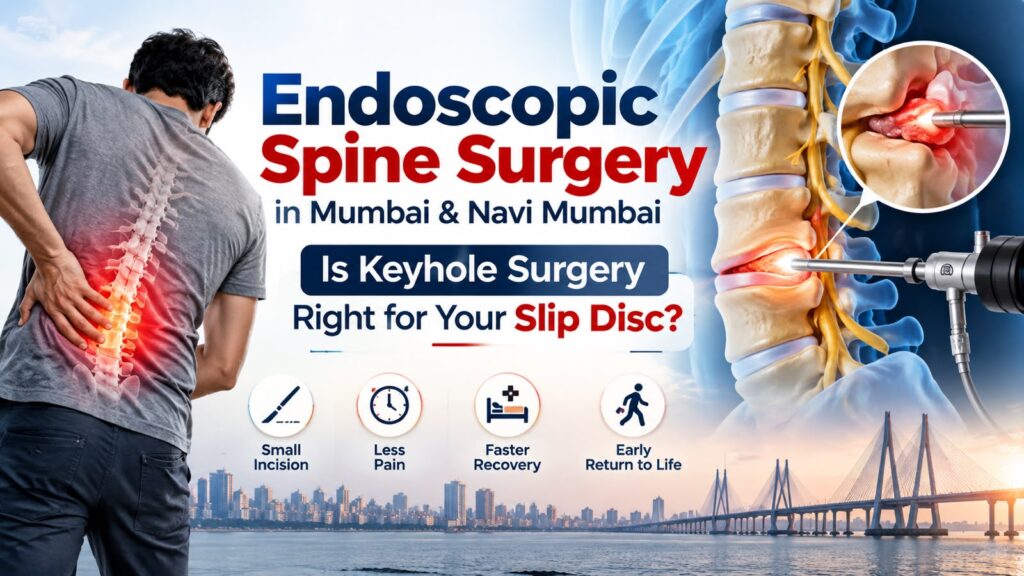
Long hours at a desk, daily local train commutes, and the Vashi-to-BKC traffic crawl all take a toll on the spine. Back pain, neck pain and sciatica are no longer “problems of old age”. Today, many people in their 20s and 30s from Mumbai, Navi Mumbai and Thane are dealing with slipped discs and pinched nerves.
The good news is that spine surgery has changed a lot. Endoscopic spine surgery, often called keyhole surgery, is now one of the most talked-about options for people who want relief without a big operation.
In this guide, Dr. Girish Sawakare, spine surgeon in Mumbai, explains what endoscopic spine surgery is, who is a good candidate, and what recovery looks like.
What Is Endoscopic Spine Surgery?
Endoscopic spine surgery is a minimally invasive technique. The surgeon makes a very small incision, usually less than a centimetre, and inserts a thin tube with a camera (an endoscope). Using the camera view on a screen, the surgeon removes only the part of the disc or bone that is pressing on the nerve.
Because muscles are gently moved aside instead of cut, the body is disturbed far less than in traditional open surgery.
Conditions That May Be Treated With Endoscopic Spine Surgery
Depending on your scans and symptoms, this approach may be considered for:
- Lumbar slip disc (herniated disc), with back pain and leg pain
- Sciatica that does not settle with medicines and physiotherapy
- Cervical disc problems and cervical spondylosis, with neck pain and arm tingling
- Spinal canal stenosis, causing leg heaviness or pain while walking
- Pinched nerve (radiculopathy)
Not every spine problem needs surgery, and not every case is suitable for keyhole surgery. An accurate diagnosis comes first.
Benefits of Endoscopic Spine Surgery
- Smaller incision and minimal scarring
- Less muscle damage, so less post-operative pain
- Shorter hospital stay, often a day-care procedure or a short stay
- Faster return to walking and daily routine
- Lower blood loss and reduced risk of infection compared to open surgery
Results depend on the condition, your overall health and the surgeon’s assessment.
Endoscopic vs Traditional Open Spine Surgery
| Factor | Endoscopic (Keyhole) | Traditional Open Surgery |
|---|---|---|
| Incision size | Very small | Larger |
| Muscle cutting | Minimal | More |
| Hospital stay | Shorter | Longer |
| Recovery | Usually faster | Usually slower |
| Suitable for | Selected conditions | Complex or multi-level problems |
When Should You See a Spine Surgeon?
Do not wait if you notice any of these:
- Back or neck pain lasting more than 4 to 6 weeks despite rest and medicines
- Pain travelling down the leg or arm
- Numbness, tingling or weakness in the hands or feet
- Difficulty standing or walking for long
- Urgent signs: loss of bladder or bowel control, or sudden leg weakness. Go to a hospital immediately.
What to Expect During Your Consultation
- Clinical examination and detailed history
- MRI/X-ray review: bring all your old reports
- Diagnosis and a clear explanation in simple language
- Treatment plan: physiotherapy, injections or surgery, whichever is genuinely needed Many patients improve without surgery. Surgery is advised only when it is the right option.
Frequently Asked Questions
Q1. Is endoscopic spine surgery safe?
When performed by an experienced spine surgeon on a suitable patient, it is considered a safe, well-established technique.
Q2. How long is the recovery after endoscopic spine surgery?
Many patients walk within hours of surgery and resume light routine work within days to a couple of weeks. Your surgeon will guide you based on your case.
Q3. Is slip disc always treated with surgery?
No. Most slip disc cases improve with medicines, physiotherapy and lifestyle changes. Surgery is considered when there is severe pain, nerve weakness or no improvement.
Q4. Who is a good candidate for keyhole spine surgery?
Patients with a confirmed disc or nerve compression on MRI, matching symptoms, and no relief from conservative treatment.
Q5. How do I find a good spine surgeon in Mumbai or Navi Mumbai?
Look for proper spine specialisation, experience in minimally invasive techniques, clear communication and honest advice about whether you need surgery at all.